Travel Guides
Getting Around China: High-Speed Rail, Flights, Metro & Long-Distance Buses
When the train beats the plane, when it does not, how much time airports actually cost, and how to move around inside a Chinese city without speaking the language.
Updated 2026-10-29 · Hidden Valley Travel
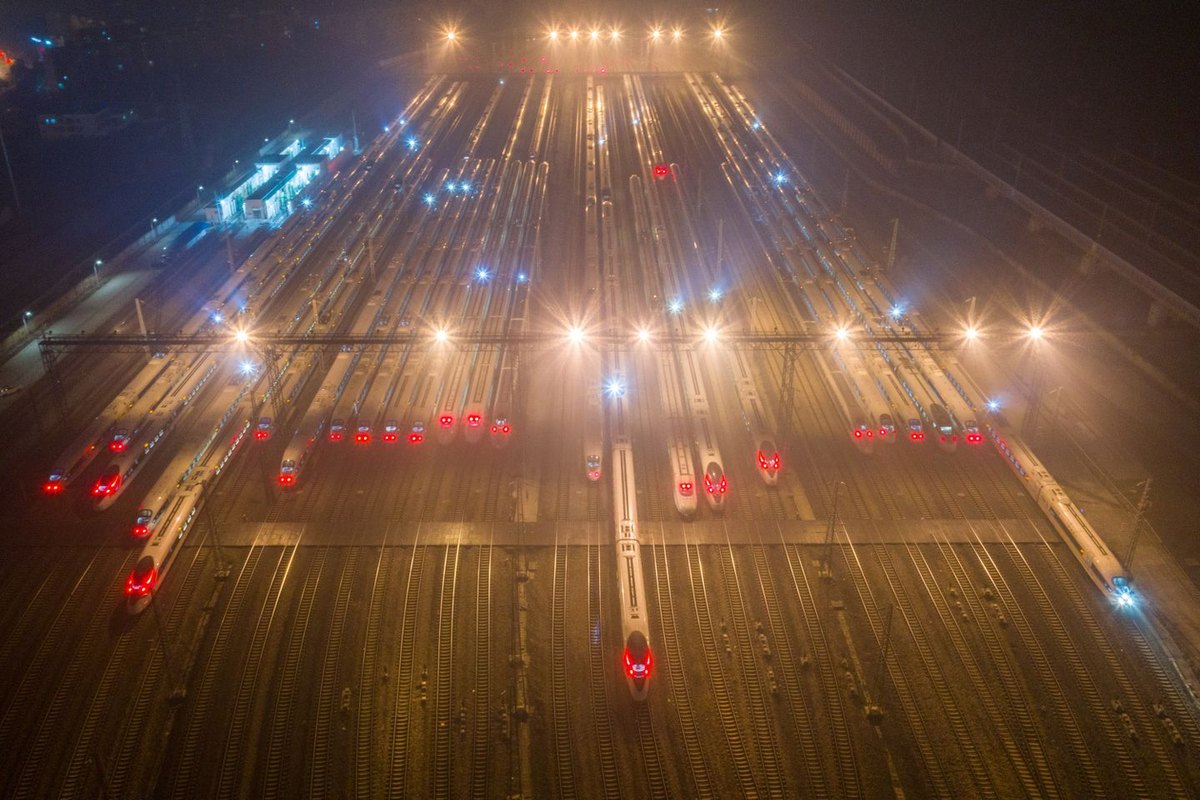
High-speed rail is the default, and not only for the scenery
China's high-speed network is about 45,000 km and covers almost everywhere a visitor wants to go. On routes under about 1,000 km it usually wins outright, because the airport costs on both ends are large: a domestic flight wants two hours of check-in and security, plus 40 to 70 minutes of transfer at each end. A Beijing–Xi'an train is 4.5 hours city centre to city centre; the flight is 2 hours in the air and about 5.5 hours door to door. Above roughly 1,200 km — Beijing to Guilin, Shanghai to Kashgar — the plane wins and we use it.
Classes and what you get
- Second class — 3+2 seating, comfortable enough for four or five hours, and what most travellers book.
- First class — 2+2, wider seats, quieter carriages.
- Business class — 2+1 on the longer trainsets, lie-flat on some, and priced close to a discounted flight. Worth it on a six-hour leg if your budget stretches.
Every seat has a power socket. Luggage goes in the overhead racks and in the space behind the last row of each carriage — there is no separate luggage van, so if you are carrying a large case, board early.
Booking
Tickets are real-name and release 15 days before departure, and on the popular legs — Beijing–Xi'an, Shanghai–Hangzhou — they can go within hours on a Friday. We book them for you as part of any itinerary. If you are travelling independently, the official app requires a Chinese phone number and a Chinese payment method in most cases, which is why most visitors book through an agency or at the station counter with a passport in hand. Names cannot be changed after issue; a misspelled passport number means a new ticket.
Inside the cities
The metro is the answer in every city that has one, which is all of the ones on this site. Signs are in English, fares are two to nine yuan, and stations are air-conditioned. Taxis are metered and cheap by Western standards; the problem is not price but that drivers often will not take a fare at a change of shift. Ride-hailing apps work in English in some cities and not in others — ask us before you rely on one. For the metro, the payment apps built into Alipay and WeChat generate a QR transit code, which removes the ticket machine entirely.
What we actually schedule
Long-distance moves go in the afternoon or evening wherever possible, so that no day is consumed by transit. Where a flight is unavoidable, we schedule it on a day with nothing else on it. And we do not schedule a flight and a Wall climb in the same 24 hours.